

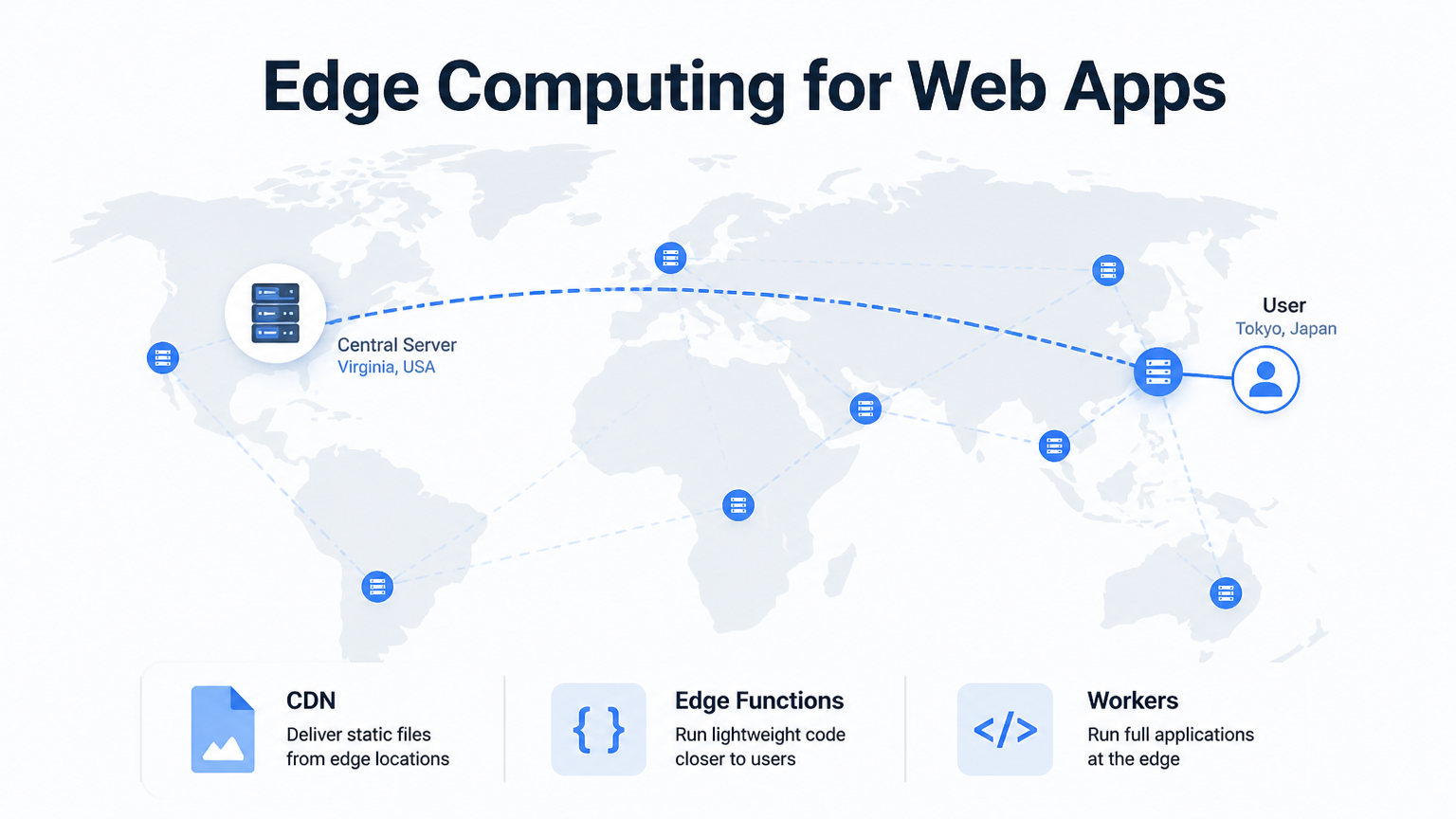
Imagine a visitor opens your web app in Tokyo. Your server sits in Virginia. That request travels about 12k kilometers just to wake up your server so you can respond. That person has already lost interest by the time the page has loaded.
That’s where edge computing enters the fray. This brings your code closer to your app’s users. You receive multiple servers worldwide instead of just one in a single location. A visitor to Tokyo pings a server in Tokyo. Fast. Done.
What Edge Computing Actually Means
Edge computing places your app’s logic on servers closest to the people visiting it. Edge is the closest point of a device to the internet. It’s not one big cloud far off in the distance. There are many smaller points everywhere.
Traditional setups send every request to one central server. Edge handles requests directly in the visitor’s location. The speed difference is huge. The response time of a central server might be 150ms. It could do it in less than 20 ms if an edge server is nearby.
The Real Benefit of Edge Computing

Speed is the big one. But the benefits of edge computing go beyond that.
Here’s what you actually get:
- Faster load times. Requests don’t travel far. Responses come back quickly.
- Lower server costs. You stop sending every tiny request to your main server. It handles less load.
- Better experience. Pages feel snappier. As a result, the visitors stay longer.
- Real-time decisions. You can check logins, run A/B tests, and route traffic before a page even starts loading.
Take a busy app as an example. Move the right tasks to the edge, and you can cut response time by more than half. And that is huge!
CDNs vs Edge Functions vs Workers
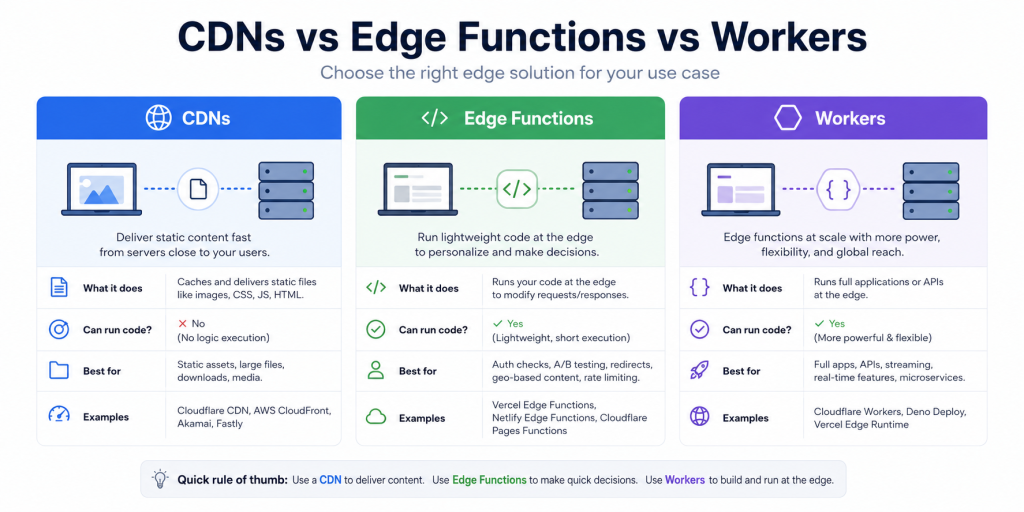
A content delivery network (CDN) stores copies of your static files, such as images and stylesheets, on remote servers close to your visitors. Great for files that don’t change much. But a CDN can’t run logic. It simply serves what you already have in storage.
Edge functions take it a step further. They run code at the edge. You can check login status, select the correct page version for a user’s country, or block bad bots before they reach your main server. It occurs all in an instant and closer to the visitor.
Workers are just edge functions with another name. Cloudflare calls theirs “Workers.” Vercel calls theirs “Edge Functions.” Deno Deploy works the same way. All they do is run some small piece of code on edge locations across the world.
When to Use Edge
Not every task belongs at the edge. Here’s where it shines:
- Login checks. Verify a session at the edge. No round-trip to your main server needed.
- A/B testing. Assign visitors to test groups instantly.
- Location-based content. Show prices in local currency without extra server calls.
- Rate limiting. Block bad traffic before it ever reaches your app.
- Quick app responses. Serve cached data in milliseconds.
These tasks are quick and don’t need heavy database access. They run cleanly at the edge.
When to Stay on Your Main Server
Some tasks need more power than edge platforms can give.
Heavy database queries don’t belong at the edge. If your code needs to join ten tables or run complex transactions, you will need to keep it on your origin server where your database lives. The extra round-trip from the edge to the database often cancels out any speed gains.
Long tasks such as PDF generation, video processing, or large-scale calculations require more time and memory than edge platforms can provide. Those belong on your regular servers.
Which Platform Should You Pick?
- Cloudflare Workers covers the most locations. They are across over 300 cities around the globe. Cold starts are nearly instant. It’s a solid choice for most apps.
- Vercel Edge Functions connect tightly with Next.js. If your app already runs on Vercel, this is the easiest way to add edge logic without making many changes.
- Deno Deploy supports TypeScript out of the box. It has fewer locations than Cloudflare, but it’s clean and straightforward to use.
Start Small
There is no need to redo the complete application. Start with one — your login check or a high-traffic API call — and take it to the edge. Measure the speed difference. Then grow from there.
The edge does not supplant your primary server. It’s the fast lane in front of it. Put the quick stuff there and let your server do the heavy lifting.
That separation alone can give your app a completely new product feel.
