

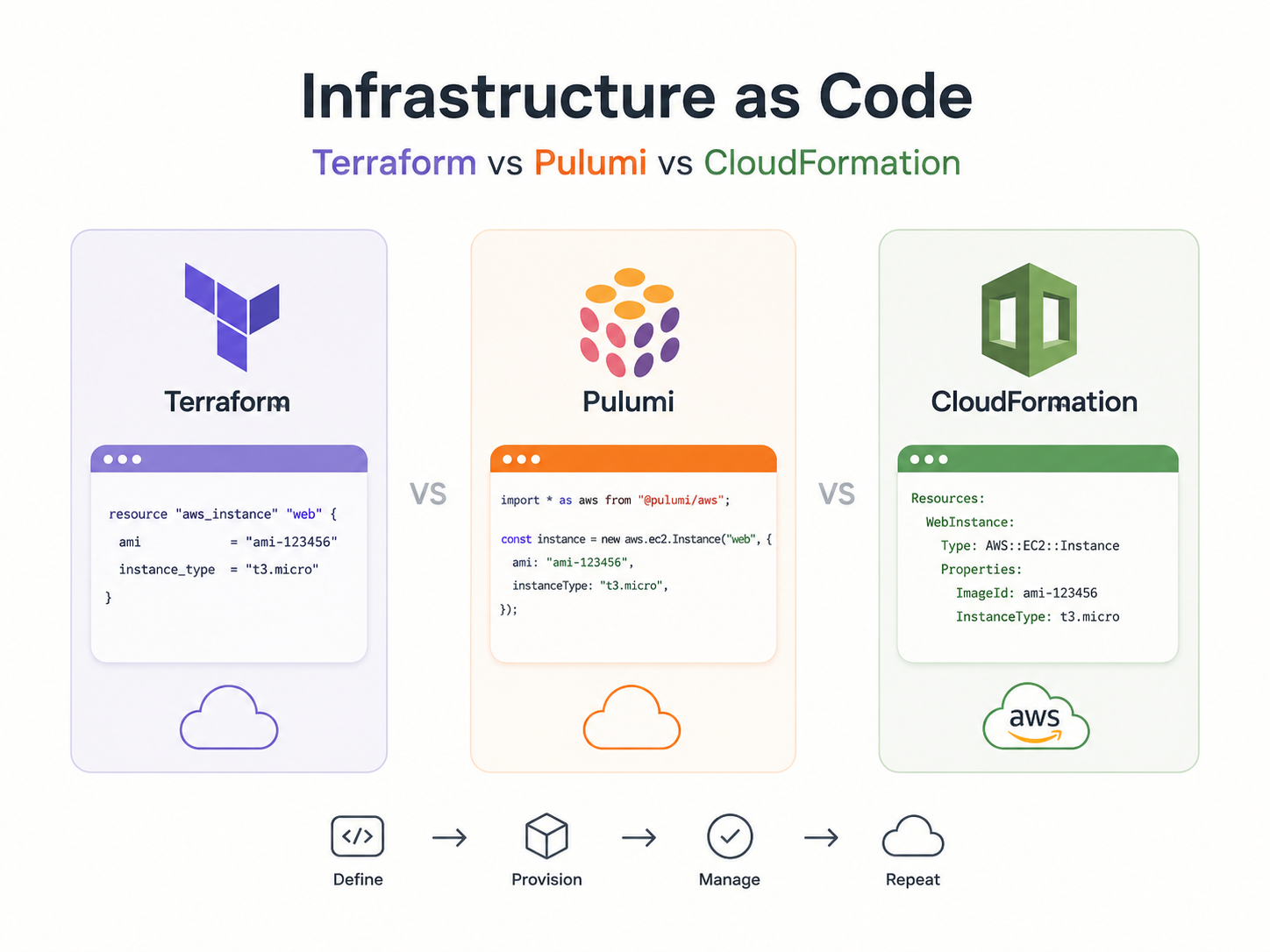
Manually creating cloud infrastructure is neither fast nor smooth. Just one wrong click and your setup is broken, and no one can understand why. This is why Infrastructure as Code (IaC) tools are used.
Infrastructure as code (IaC) tools allow you to define your cloud configuration using code files. With a single command, your infra is constructed. No more clicking around in the AWS console. No need to wonder what someone changed last week.
Terraform, CloudFormation, and Pulumi are the three largest players today. All of them solve the same basic problem, but go through very different processes to get there.
Why Use Infrastructure as Code?
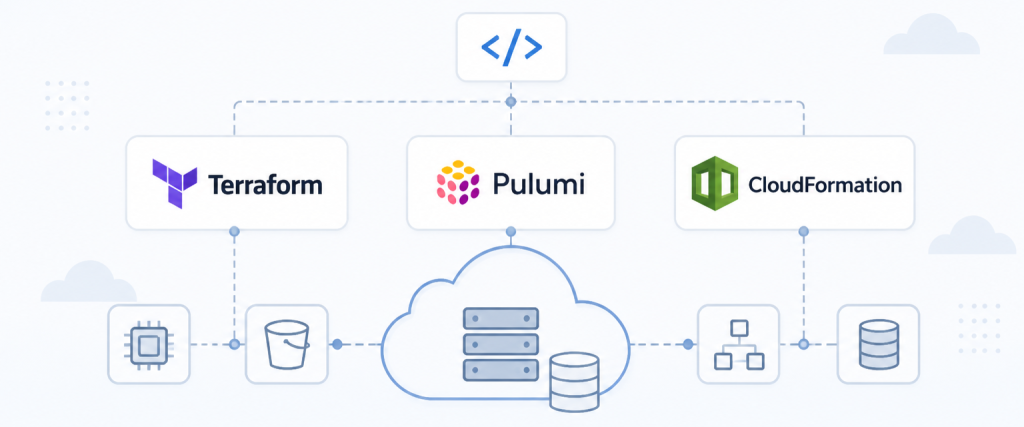
IaC treats your cloud setup like software. You write the code, run it, and your infra appears. If something breaks, you fix the code and redeploy. Simple as that.
Here’s what IaC gives your team:
- Faster deployments across AWS, Azure, and GCP
- Fewer config mistakes than manual setups
- Full version control so you can track every change
- Easy copies of the same setup across different environments
Terraform
Terraform is the most popular IaC tool at present. HashiCorp built it in 2014. It defines cloud resources with a language called HCL. HCL is pretty much like plain English, so most devs pick it up rather quickly.
Multi-cloud support is the biggest strength here. You can deploy on AWS, Azure, GCP, and literally hundreds of other providers from one tool. This is very valuable to teams across multiple clouds.
Pros:
- Supports many cloud providers
- Huge community with loads of examples and ready-made modules
- Reusable modules cut down on repeated code
- Declarative style: say what you want, and Terraform figures out the rest
Cons:
- No longer fully open source after HashiCorp switched to a more restrictive license
- State files can store unencrypted secrets
- Testing needs third-party tools like Terratest
Terraform works best for teams that span multiple clouds and want solid community support.
AWS CloudFormation
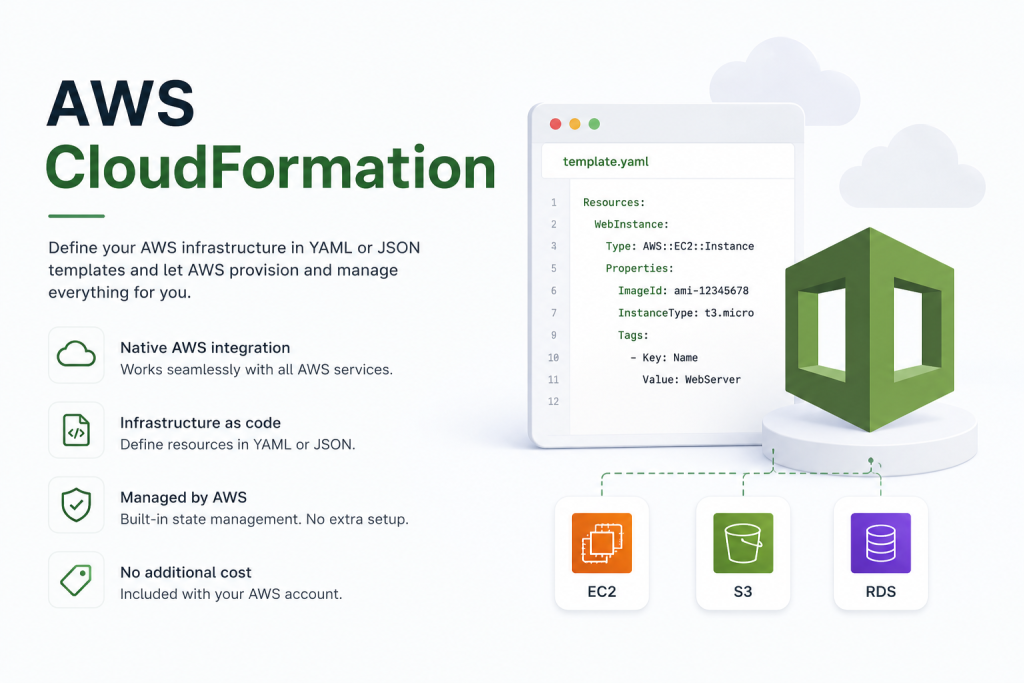
AWS also has its own IaC tool, CloudFormation. This one was first released by Amazon in 2011. You specify your setup in YAML or JSON, and AWS takes care of the rest.
The most significant victory, however, is deep integration with AWS. All AWS services are designed to work out of the box with CloudFormation. Within your AWS account, state management is handled for you automatically. No extra storage setup needed. Best of all, you don’t pay anything extra to use it.
Pros:
- Tight AWS integration right out of the box
- Built-in state management
- Free as part of your AWS account
Cons:
- Only works with AWS. Zero multi-cloud support
- YAML files grow very long with complex infra
- Limited code reuse and testing options
Your whole stack runs on AWS, and you have no plans to move? CloudFormation keeps things simple.
Pulumi
Pulumi launched in 2018. It takes a completely different approach. Instead of learning a brand new language, you need to write infrastructure code in Python, Go, TypeScript, or Java. Developers who already code every day tend to love this setup.
Pros:
- Use languages you already know
- Handles complex logic like loops and conditions with ease
- Strong built-in secret management
Cons:
- Hard to get started if you come from a non-coding background
- Docs are still thinner than Terraform’s
- Project structure gets complicated as infra grows
Pulumi suits dev-heavy teams that want full coding power baked into their infra.
Quick Comparison
| Feature | Terraform | CloudFormation | Pulumi |
| Language | HCL | YAML or JSON | Python, Go, TS, Java |
| Multi-cloud | Yes | No | Yes |
| Open source | Partial | No | Yes |
| State management | Manual setup | Built-in | Manual or Pulumi Cloud |
| Best for | Multi-cloud teams | AWS-only teams | Dev-heavy teams |
Which Tool Should You Use?
Here’s the simple breakdown:
- Choose Terraform for Multi-cloud and a strongly supported community
- Choose CloudFormation when you run AWS only and want no additional setup.
- Choose Pulumi if your team is already writing code and wants to avoid HCL.
Your cloud setup, your team’s skills, and your infrastructure’s complexity will ultimately determine which option is right for you. Not every tool applies to every solution. Do a test run, see how it feels, and expand.
